Color SicBo is SimplePlay’s coloured-dice carnival product, and its official description says it uses three identical dice with six differently coloured faces each. It differs from JILI Color Game in product identity and publisher; the evidence does not support calling one a ball game and the other a dice game. This guide separates documented mechanics from board details that still need the exact in-game rules.
Sources: SimplePlay - Color SicBo SimplePlay - Table Games Games | JILI Games
Perya Tala Editorial Desk · Published 2026-10-31 · Source review 2026-10-31
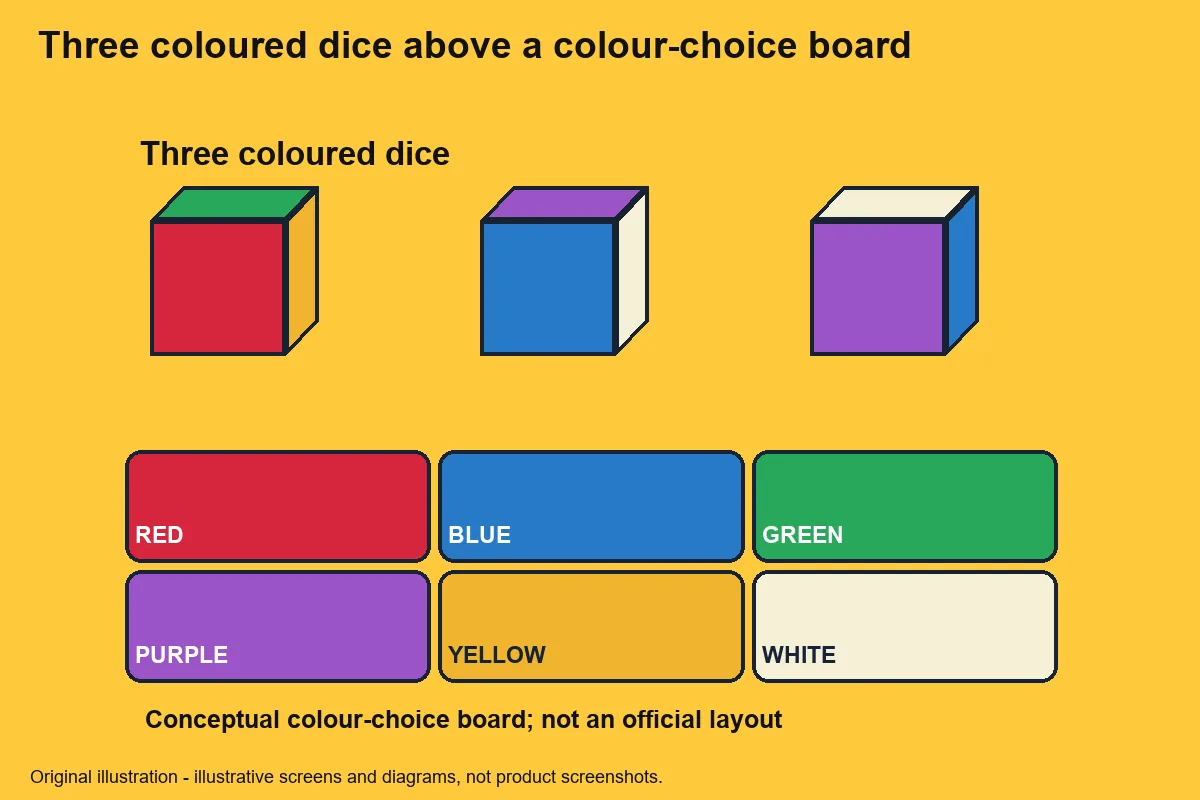
- What Color SicBo is
Color SicBo is a named product, not a universal rulebook for everything sold under a colour-game label. SimplePlay describes players choosing colours they expect to face upward after a roll. That gives us a basic object and action: coloured faces on dice, followed by a displayed outcome. It does not establish every timing rule, settlement condition or screen label.
The publisher places the title in its table-game catalogue. A catalogue entry helps establish where a product belongs within that publisher’s presentation; it is not evidence that every operator carries the same release. Keep the product name alongside the publisher when taking notes, especially if another screen uses a shortened title.
The familiar word SicBo should not lead a reader to import rules from a numbered-dice game. The description checked here explicitly concerns colours. Rules for a different product, even one with a similar name, cannot fill gaps in this page. Nor can a colourful illustration tell us which combinations settle or whether a return includes an original stake.
SimplePlay - Color SicBo · Retrieved 2026-10-31. Games | JILI Games · Retrieved 2026-10-31. SimplePlay - Table Games · Retrieved 2026-10-31.
- Board anatomy from the official page
The safest board map separates colour-selection areas from the area that reports the completed roll. This is a conceptual reading aid based on the publisher’s description, not a reconstruction of a tested interface. The diagrams deliberately use labels rather than copied controls, so their placement must not be mistaken for the actual mobile layout.
Colour areas
A colour area represents a choice within the game’s stated coloured-dice premise. Its colour alone is not a sufficient explanation of settlement. A full rule needs to connect that choice to an outcome condition, including how matches are counted and what happens when several dice show the same colour. The official description discusses the number of dice showing a specified colour, but a complete mapping of every available choice remains unverified [待核實].
When reading an actual rules panel, copy the written colour label as well as its visual appearance. Two shades that look similar on a small screen may have different names. Do not rename an unfamiliar colour to fit a personal shorthand and then use that shorthand as a quotation. If a label cannot be read, record the uncertainty rather than filling it from memory.
Result display
A result area reports an outcome; it should not be confused with the area where a choice was entered. The official premise concerns the upward-facing colours after a roll. A record of a selected colour answers a different question from a record of what the dice displayed. Preserve that distinction even if a screen places those values close together.
Our source review did not establish an exact result-history layout, timestamp format or retention period. Those details remain unverified [待核實]. A mock panel in this article is therefore an example of fields worth distinguishing, not a promise that the released product has those fields. An absent timestamp should stay absent in a transcription.
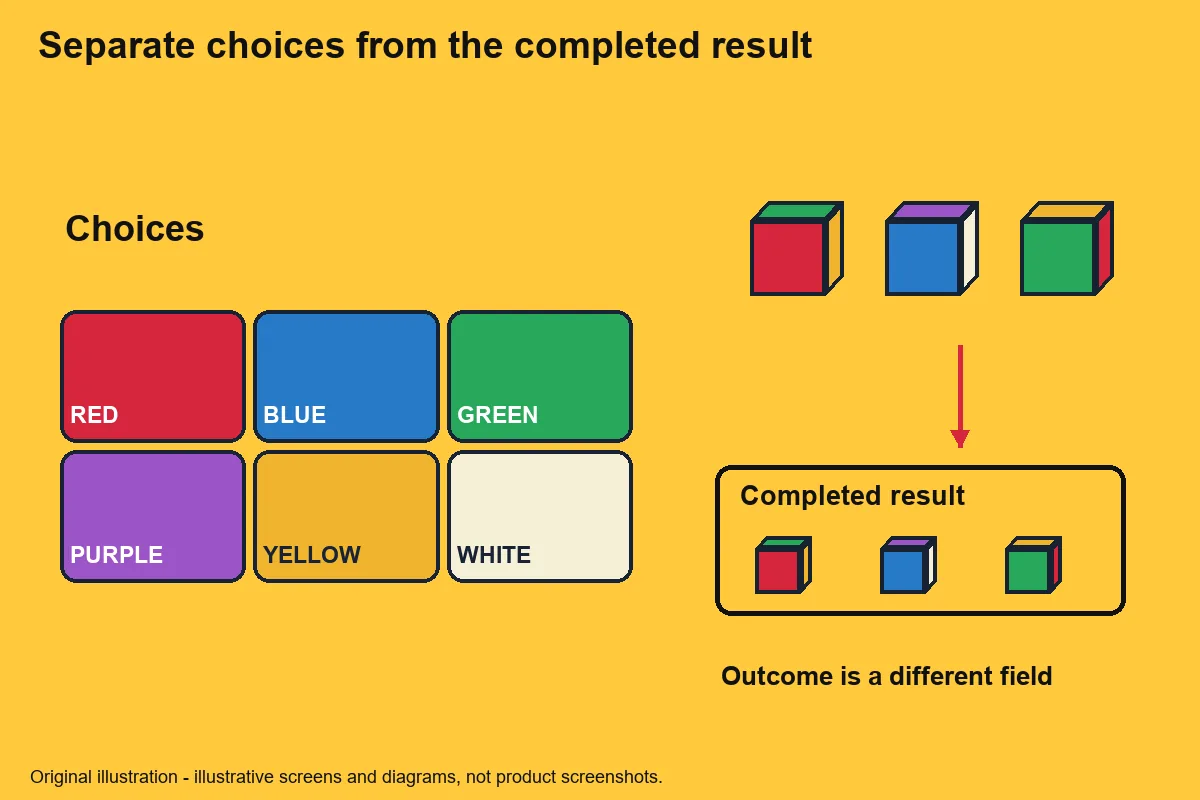
Original field-note diagram, not a live game screenshot. SimplePlay - Color SicBo · Retrieved 2026-10-31.
- How it differs from a dice Color Game
The supported difference is between two identified products, while both descriptions involve coloured dice. SimplePlay names Color SicBo; JILI names Color Game. JILI’s page describes colour matches and double or triple outcomes. These similarities make identity checking more important, not less: shared vocabulary cannot establish a shared implementation.
Product identity, not payout comparison
Compare the publisher, exact title and available document before comparing a board. An editorial note might say “SimplePlay / Color SicBo / official product page” in one column and “JILI / Color Game / official product page” in the other. That is a factual comparison with a clear evidence boundary. Calling either entry a clone would require additional evidence we do not have.
The two promotional pages are not a suitable basis for declaring which game is more favourable. Marketing claims may omit conditions needed for a meaningful comparison. This article therefore does not calculate expected returns, rank payouts or translate a maximum into an ordinary outcome. It also does not assert that a Philippine regulatory listing for one similarly named title applies to the other.
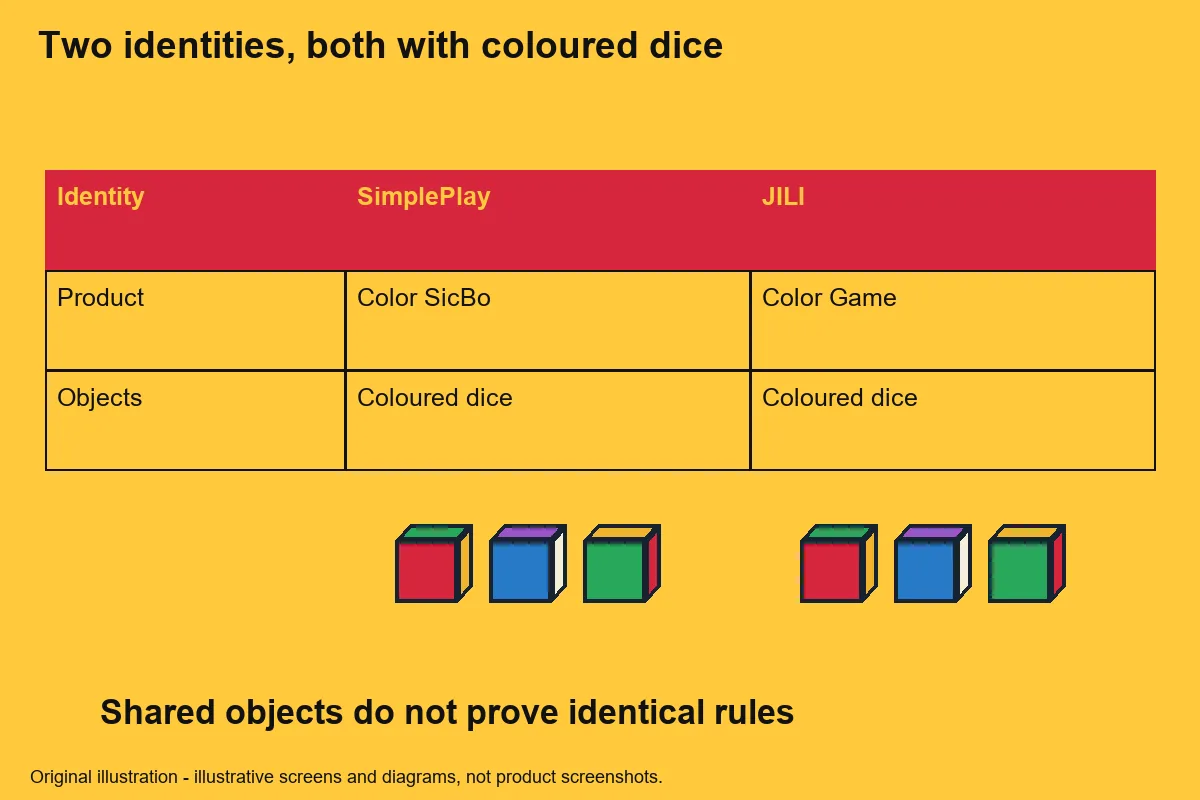
Original field-note diagram, not a live game screenshot. SimplePlay - Color SicBo · Retrieved 2026-10-31. Games | JILI Games · Retrieved 2026-10-31.
- Reading a completed round record
A useful completed-round note keeps the reported outcome separate from the reader’s interpretation. Begin with whatever identifies the product and round on the actual screen. Then transcribe the displayed colours or labels in their visible order, if an order is supplied. Do not assign a left-to-right dice order when the record itself does not provide one.
For an illustrative note, imagine a record with a product heading, a completion marker and a row of colour names. The heading identifies the source; the marker indicates the record’s status; the names describe the displayed result. None of those fields, by itself, states the settlement rule. This example is invented to explain reading, not presented as an observed Color SicBo screen.
If a result entry and a balance entry appear inconsistent, save their surrounding labels before drawing a conclusion. A display may refer to a different round, a selected choice or a completed result. The precise explanation for any real discrepancy requires that product’s rules and records; it is not something this guide can resolve from a generic diagram.
Older entries are historical information. A run of one colour in a history strip does not supply a verified rule for the next outcome. Avoid adding arrows labelled “next” or “due” to a record. Such annotations change a factual log into a forecast without evidence and distract from the basic task of identifying what was actually displayed.
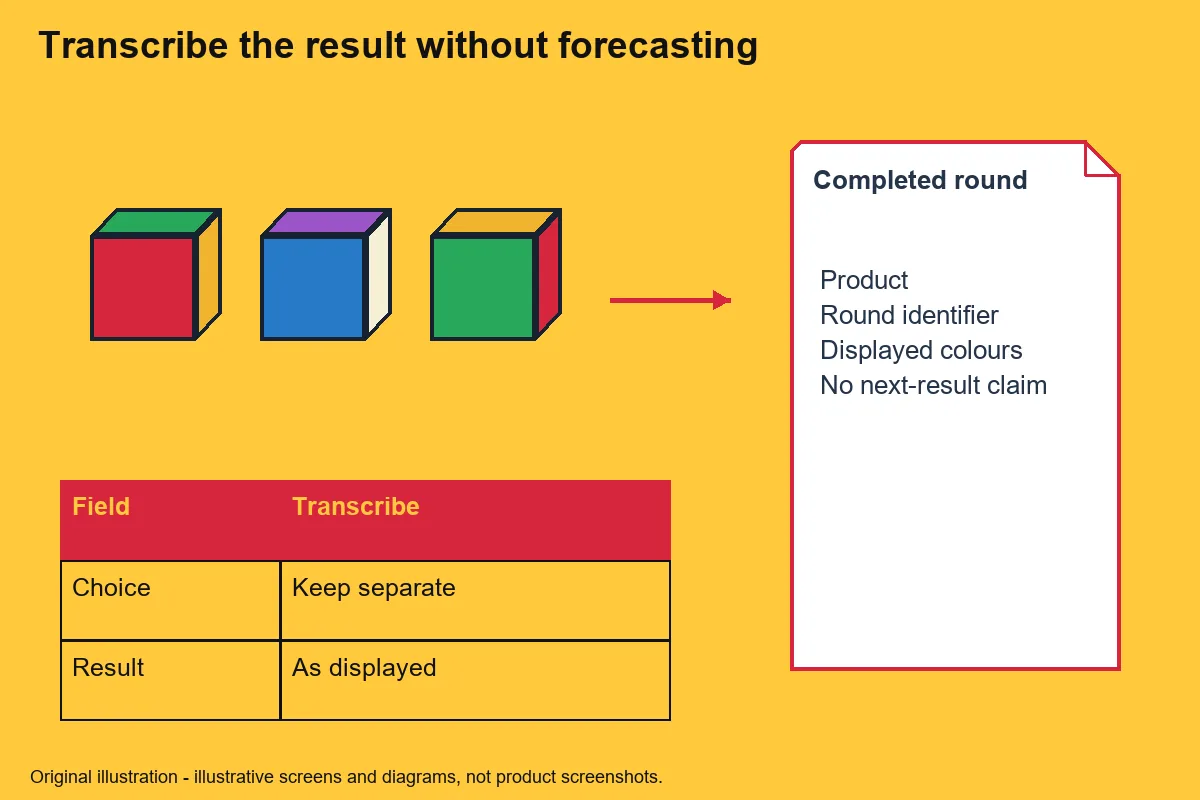
Original field-note diagram, not a live game screenshot. - What the official page does not state
The product page establishes the coloured-dice premise and some advertised features, but it is not a complete operating manual. It mentions animated chips and a particular promotional payout condition. That means it would be inaccurate to describe the source as containing no feature or payout information. We have simply not reproduced those numbers as a substitute for full rules.
Exact mobile placement, full settlement tables, interruption handling and the version offered by a particular operator remain unverified [待核實]. A screenshot of a publisher header would not settle those questions either. Before expanding this guide, an editor should obtain the relevant rules panel, preserve its version and capture date, and connect each new statement to that evidence rather than to a familiar-looking board.
SimplePlay - Color SicBo · Retrieved 2026-10-31.
Official references
- SimplePlay - Color SicBo · 2026-10-31
URL subject and content checked; not operator endorsement
- SimplePlay - Table Games · 2026-10-31
URL subject and content checked; not operator endorsement
- Games | JILI Games · 2026-10-31
URL subject and content checked; not operator endorsement
待核實 / Unverified details
- The official description discusses the number of dice showing a specified colour, but a complete mapping of every available choice remains unverified [待核實].
- Those details remain unverified [待核實].
- [sicbo] Exact mobile placement, full settlement tables, interruption handling and the version offered by a particular operator remain unverified [待核實].
Questions and answers
- Is Color SicBo the same as Color Game?
No. SimplePlay Color SicBo and JILI Color Game have different publisher identities. Both official descriptions refer to coloured dice; that does not establish identical rules or interfaces.
Official reference 1 Official reference 2 Official reference 3
- Who publishes Color SicBo?
The product page used here belongs to SimplePlay and names Color SicBo. A similar title elsewhere is not enough to identify the same product.
Official reference 1 Official reference 2 Official reference 3
- Where are the official rules?
Start with the identified publisher page, then consult the rules attached to the exact product and version. The linked promotional page is not a complete settlement manual.
Official reference 1 Official reference 2 Official reference 3
- Does the page list payouts?
It makes a specific promotional payout claim, so it would be incorrect to say it contains no payout information. A complete payout table and its conditions were not established from that page alone [待核實].
Official reference 1 Official reference 2 Official reference 3