Pula Puti and Color Game are not interchangeable board labels in the two official products checked here. SimplePlay’s Pula-Puti describes balls landing on coloured squares, while JILI’s Color Game describes coloured dice. Their records therefore need to be read against different outcome objects, rather than merged into one generic colour-history guide.
Sources: SimplePlay - Pula-Puti Games | JILI Games
Perya Tala Editorial Desk · Published 2026-10-31 · Source review 2026-10-31
- One-paragraph answer
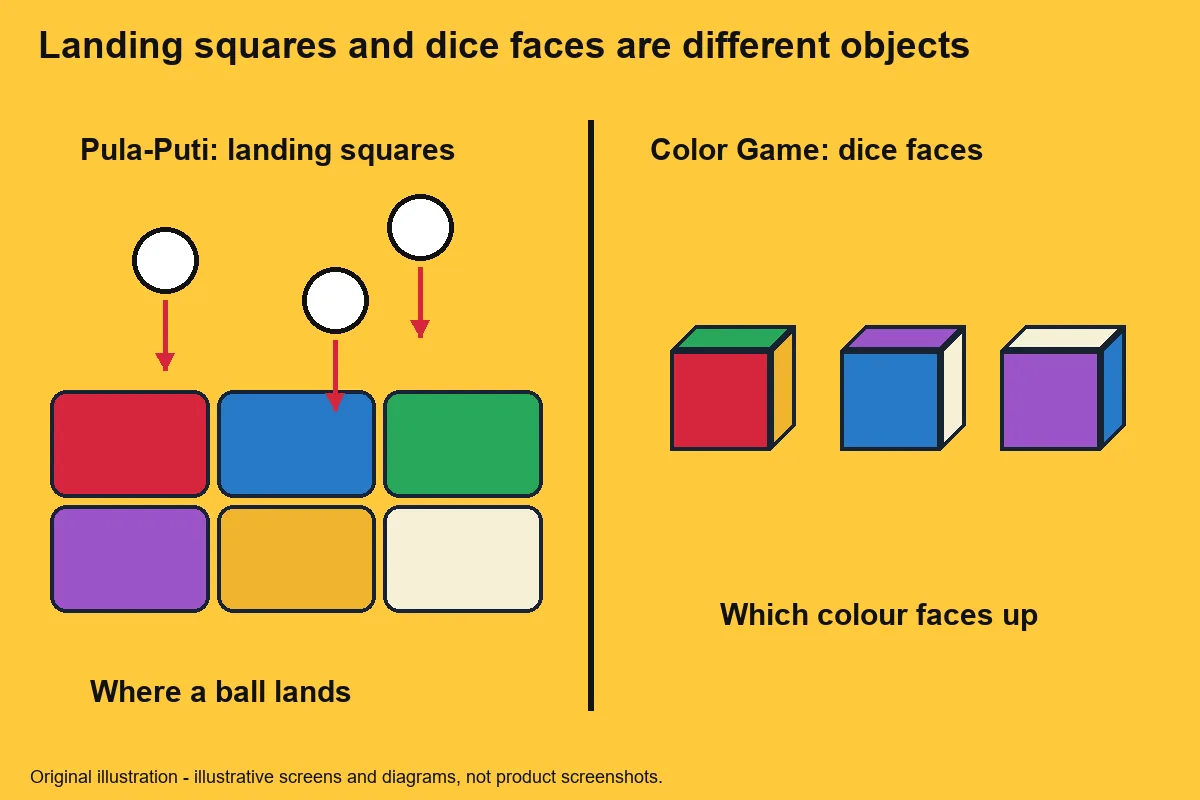
The clearest difference is what produces the displayed colour: a landing square for a ball in SimplePlay’s description, versus an upward-facing die colour in JILI’s description. That distinction helps readers understand a result label without implying that the two games share a settlement table. Similar colours, carnival themes and short product names do not establish equivalent rules.
Consider an explanatory drawing with a circle above a coloured square beside a cube with a coloured face. The circle represents a ball whose landing location matters; the cube represents a die whose shown face matters. Those drawings are conceptual. They do not reproduce either game’s arrangement, identify a real round or show a measured probability. Their purpose is to prevent a basic category mistake when reading a record.
This comparison is intentionally about document-supported board meaning. It is not an account-opening guide, a payout ranking or a claim about which game is available at a particular operator. Questions about access, account settlement or current authorisation need separate evidence tied to a particular service and product version.
SimplePlay - Pula-Puti · Retrieved 2026-10-31. Games | JILI Games · Retrieved 2026-10-31.
- Publisher and product identity
An accurate comparison begins with “SimplePlay Pula-Puti” and “JILI Color Game”, because the publisher is part of the identification. SimplePlay’s page describes a Philippine street-game background and the ball-and-square objective. JILI’s official product page supplies the contrasting coloured-dice description. Neither name should be silently replaced with a similarly titled listing from another business.
Write down the exact spelling from each source. A hyphen, space or local-language label may look minor in ordinary prose but can matter when locating a record. Preserve the original title first, then explain any shortened form in the article. A search result containing only “colour game” does not establish which product was found.
PAGCOR’s electronic gaming licensing page provides regulatory context and access to official materials. It does not make every publisher description an approved entry. This review did not establish an exact current match for both named products, so their individual listing status remains unverified [待核實]. That uncertainty must not be replaced with a blanket sentence saying both are approved.
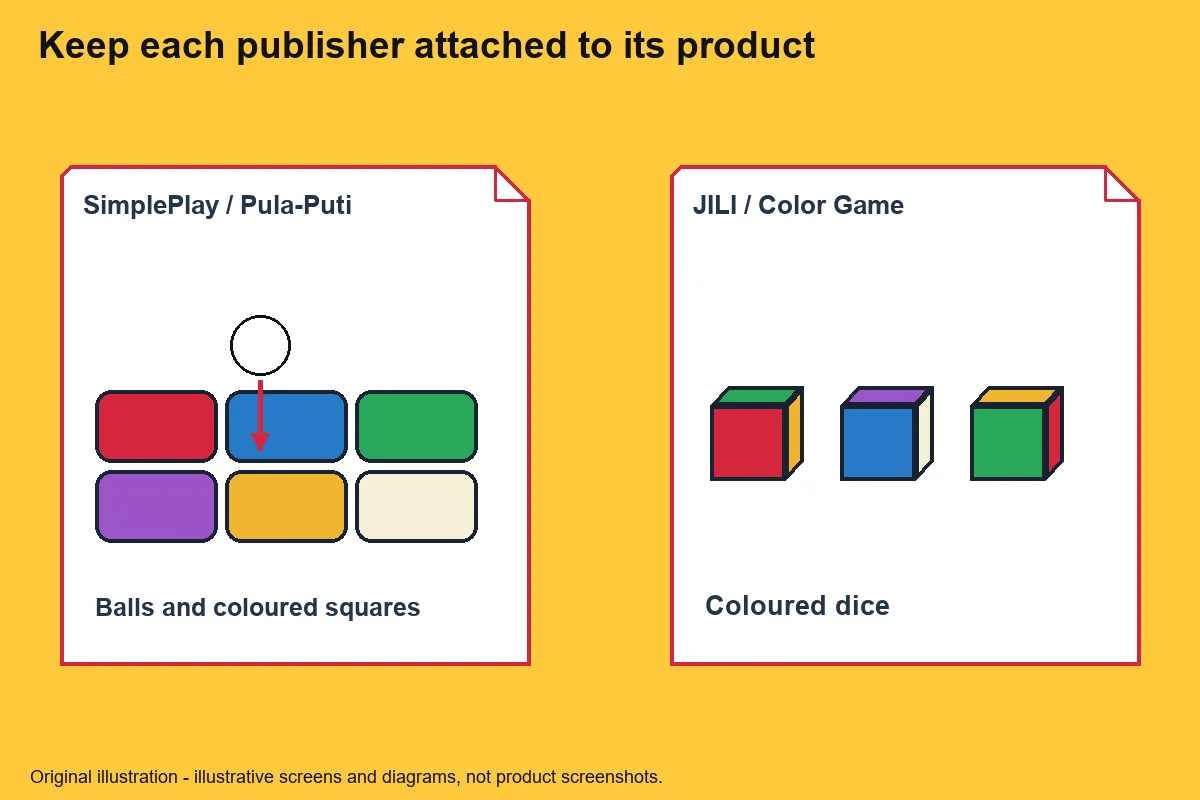
Original field-note diagram, not a live game screenshot. SimplePlay - Pula-Puti · Retrieved 2026-10-31. Games | JILI Games · Retrieved 2026-10-31. PAGCOR Regulatory site · Retrieved 2026-10-31.
- What each result record shows
The meaning of a recorded colour depends on whether the underlying description concerns a ball’s landing square or a die’s visible face. A colour label without its product context is incomplete evidence. Readers should keep the object, result label and any completed-round identifier together instead of copying only a coloured mark into a personal log.
Balls vs dice faces
For Pula-Puti, the publisher’s wording connects the objective to the colours of squares where balls land. A careful note would therefore preserve any displayed association between a ball result and a square colour. It would not rename the field “dice face” merely because another colour game uses that expression. The exact number and arrangement of result fields on the live interface were not verified [待核實].
For JILI Color Game, a note needs to respect its coloured-dice premise. The official page refers to double and triple outcomes, but those terms should not be detached from their own rules and used as a universal translation for another product. A label describing repeated dice colours does not automatically describe several balls landing on the same colour.
A generic record sheet can use separate columns for product, outcome object, visible result and source. If the source shows only a completed outcome without a timestamp, leave the timestamp field empty. If the screen shows a selected choice beside the result, identify both independently. Never turn an unlabelled colour into a recorded selection simply because its position looks familiar.
When two records look different, first ask whether they describe the same event type. One could be a summary, another a detailed round view. Without the actual interface and rules, the difference remains unresolved. A comparison article should explain that evidence gap instead of drawing a realistic-looking panel and presenting its invented structure as a product fact.
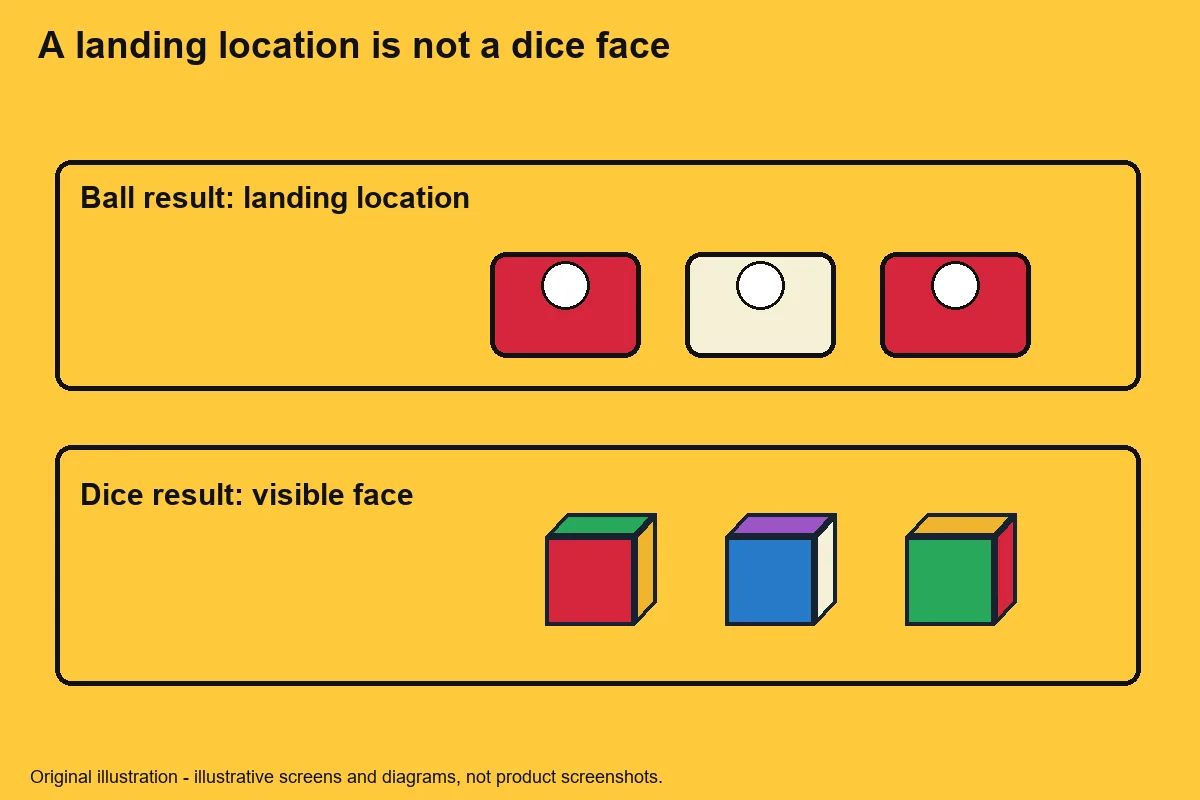
Original field-note diagram, not a live game screenshot. SimplePlay - Pula-Puti · Retrieved 2026-10-31. Games | JILI Games · Retrieved 2026-10-31.
- Screen layout differences on mobile
No exact mobile-layout comparison was verified, so this section explains reading checks rather than reporting a device test. Official promotional text is enough to identify the basic objects, but it does not establish how a current phone view arranges history, controls or help. The four images are original explanatory artwork, not captures of those interfaces.
On a small display, start by locating the product title and the label that identifies a completed result. Read an entire row before interpreting a coloured icon. A cropped view may hide a heading that explains whether a value is an outcome, a selection or a summary. These are general document-reading precautions, not claims that either product places a particular control at a particular edge.
Colour should be read with available text. Screen brightness, image compression and personal colour perception can make similar shades hard to distinguish. If written labels are absent or unreadable, record that limitation. Guessing a shade from a low-resolution picture produces a less reliable note than stating that the source cannot be read.
If an editor later obtains an official mobile capture, keep the full context before cropping a detail. Note the product, version if shown, capture date and view orientation. A narrow crop can illustrate one label but cannot prove how the whole screen behaves. The current draft does not claim responsiveness, accessibility compliance or usability performance for either product.
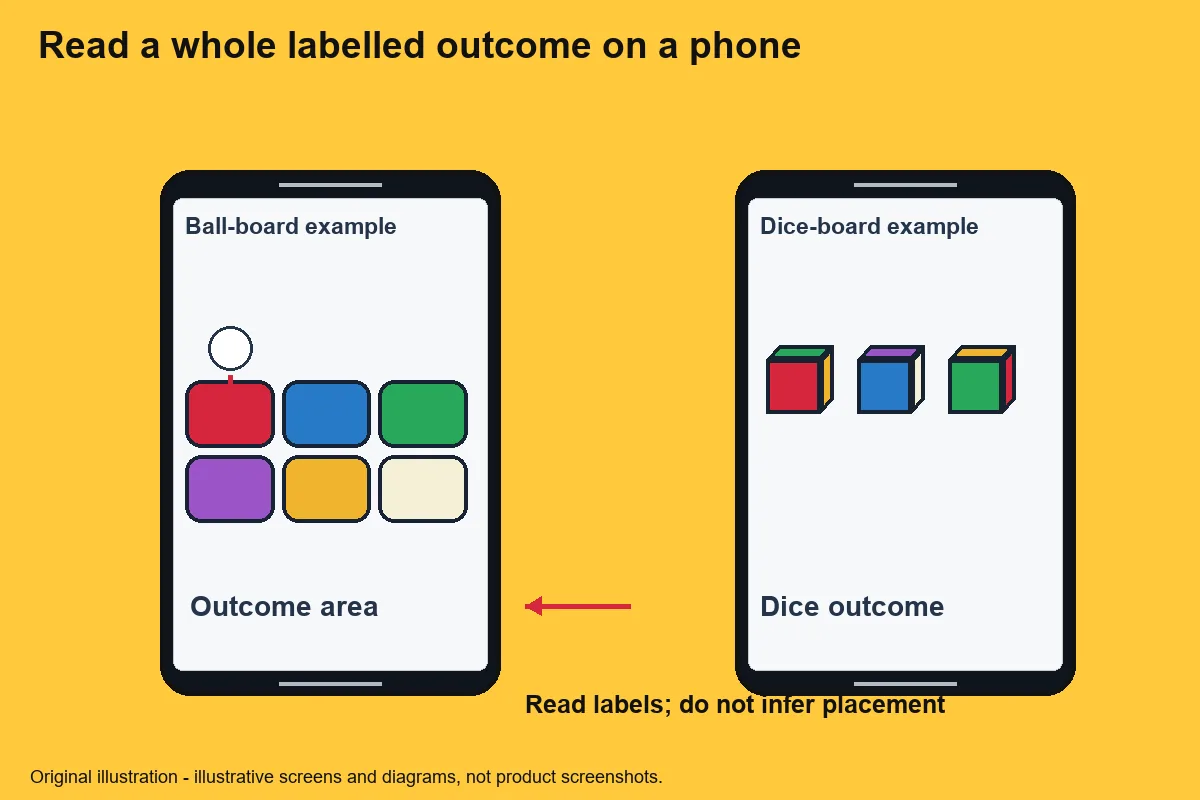
Original field-note diagram, not a live game screenshot. SimplePlay - Pula-Puti · Retrieved 2026-10-31. Games | JILI Games · Retrieved 2026-10-31.
- Shared limits: no prediction, no strategy
A result record explains a past display and does not supply a verified method for choosing a future outcome. Repeated colours in a short history are still past entries. This article does not infer that a colour is overdue, that one product compensates for previous outcomes or that switching between them changes a reader’s prospects.
The publisher descriptions also do not support a comparison of personal affordability or expected winnings. Promotional wording should not be converted into a statement that one board is safer or more profitable. A description of how an outcome is represented is different from evidence about the complete mathematics or an individual’s risk of harm.
Where the evidence ends, the comparison ends. Complete settlement tables, interrupted-round handling, exact product-version listings and current operator implementations remain unverified [待核實]. Keeping these boundaries visible gives an editor a useful update list while allowing the central, supported distinction—balls on squares versus coloured dice—to remain clear and concise.
Official references
- SimplePlay - Pula-Puti · 2026-10-31
URL subject and content checked; not operator endorsement
- Games | JILI Games · 2026-10-31
URL subject and content checked; not operator endorsement
- PAGCOR Regulatory site · 2026-10-31
URL subject and content checked; not operator endorsement
待核實 / Unverified details
- This review did not establish an exact current match for both named products, so their individual listing status remains unverified [待核實].
- The exact number and arrangement of result fields on the live interface were not verified [待核實].
- Complete settlement tables, interrupted-round handling, exact product-version listings and current operator implementations remain unverified [待核實].
Questions and answers
- Which one uses dice?
JILI Color Game describes coloured dice. SimplePlay Pula-Puti describes balls landing on coloured squares. These statements concern the named products, not every game using similar names.
Official reference 1 Official reference 2 Official reference 3
- Are both PAGCOR-listed?
The exact product and version matches were not established in this comparison [待核實]. A publisher page and the PAGCOR licensing portal do not by themselves prove two individual entries.
Official reference 1 Official reference 2 Official reference 3
- Can past results predict the next round?
A history display does not provide a verified prediction method. This article makes no forecast and does not recommend a betting sequence.
Official reference 1 Official reference 2 Official reference 3
- Which page has the official rules?
The publisher pages establish the basic product descriptions. Complete settlement rules should come from the identified product’s own rule panel or corresponding official documentation; the full panels were not verified here [待核實].
Official reference 1 Official reference 2 Official reference 3